To find your scar camouflage tattoo cost, request a written quote for your individual request rather than treating a general advertised amount as your total. Ask whether the amount covers everything discussed or whether additional appointments would be quoted separately. For your 2026 budget, keep the financial quote separate from any discussion of suitability or expected results.
- Scar camouflage tattoo cost needs a clearly defined quote, not an assumed total.
- Ask what the quote includes and how any additional appointments would be handled.
- Essence emphasizes soft, natural, individually designed permanent makeup; discuss restorative requests directly.
- A written quote explains the proposed expense; it does not establish suitability or promise results.
How much does scar camouflage tattoo cost?
The useful number is the amount quoted for your specific request, with its scope and exclusions written beside it. Before using a figure to plan your budget, establish what that figure represents: an appointment, a defined piece of work, or the complete proposal you discussed.
For prospective clients in Lynchburg and nearby communities, Essence is a place to begin that conversation about permanent makeup or medical tattooing. Describe what you want to discuss, then request details about the proposed service and its cost without assuming that a particular approach is appropriate for you.
A quote becomes easier to evaluate when its wording answers the questions below. Use this comparison to identify what still needs clarification, not to rank providers by the lowest headline amount.
| Quote format | Best for | What it tells you | What still needs clarification |
|---|---|---|---|
| General advertised amount | Beginning your research | An amount associated with an advertised service | Whether it applies to your request and what it includes |
| Appointment-based quote | Understanding the expense of a specified appointment | The amount assigned to that appointment | Whether later appointments are included or separate |
| Written, scoped proposal | Reviewing a specific budget | The amount and the work expressly described | Anything left outside the written scope |
None of these formats establishes an outcome. Even a detailed proposal needs a separate conversation about your expectations before you decide whether to proceed.
Why this matters
Your reason for asking about cost is practical: you want to know what you would be agreeing to spend. A number without a clear description leaves that question unfinished.
For your 2026 comparison, place the amount next to the exact service description. If one proposal describes a single appointment and another describes something different, do not treat the totals as equivalent until you have asked for clarification.
You also deserve room to ask questions without committing. A useful inquiry ends with a clearer understanding of the proposal, even when your decision is to pause.
What should your written quote explain?
Start with the scope, then work through the financial details. You do not need technical language to ask for a clear explanation.
The request being quoted
Ask for a plain-language description of what the proposal covers. Identify the area you want to discuss and the appearance you are hoping to explore, without deciding the method yourself.
Read the description back against your original request. If the wording is broader or narrower than you expected, resolve that difference before using the quote as your budget.
What the stated amount includes
Ask which parts of the proposed service are included in the amount. Do not fill gaps with assumptions about consultations, design discussions, appointments, or later work.
A useful question is: Does this amount cover the complete proposal described here, or only a particular appointment? Request an answer that uses the same terms as the written quote.
What would be quoted separately
Ask how anything outside the stated scope would be handled. This is a request for the provider's actual terms, not a reason to assume that additional work will be needed.
Keep the distinction clear: an excluded item is not automatically a required item. You want to understand the proposal as written, rather than build a budget around possibilities that have not been discussed.
What you would be agreeing to
Before booking, ask to see the applicable payment and appointment terms. Read those terms directly instead of relying on what another business offers or what a friend experienced elsewhere.
For a 2026 appointment request, confirm that the quote and terms apply to the proposal you are considering now. Keep the written version you receive so you can return to it when questions arise.
Why quote requests differ
Your inquiry should reflect your own goals, not a standard description copied from someone else's experience. These details help you explain the request; they are not a formula for calculating a price.
- Your stated goal. Explain what prompted the inquiry and what you want to discuss. Avoid promising yourself a particular result before that conversation.
- The area being discussed. Identify the area clearly enough for the provider to understand your request. Ask how to share any further information privately.
- Your design preferences. Describe what soft or natural means to you rather than assuming those words mean the same thing to everyone.
- The proposed scope. Ask whether the quote concerns an initial discussion, a specific appointment, or another expressly described service.
- Your unanswered questions. Separate questions about expense from questions about suitability, expectations, and the proposed approach.
Describe your goal first; ask the provider to explain the proposal second. That order keeps you from choosing a service name simply because you have seen it attached to an appealing number.
How do you request a useful quote?
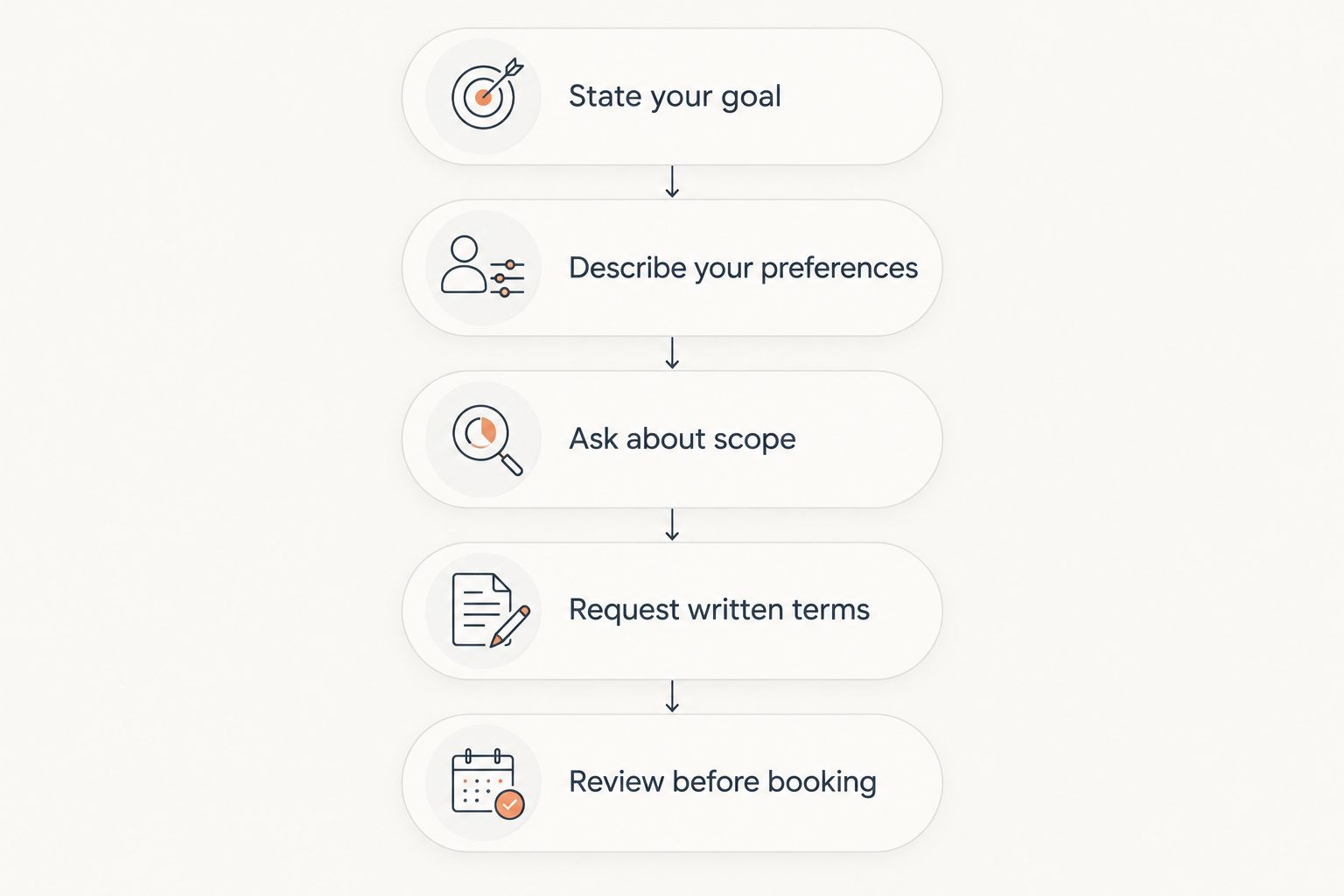
Prepare a short inquiry that gives the conversation direction without trying to settle every detail in a message. The following sequence keeps your request focused.
- State your goal. Say that you are asking about scar camouflage tattooing and explain what you want to discuss in your own words.
- Describe your preferences. Explain your interest in an understated appearance, if that reflects your preference. Do not substitute someone else's result for your own expectations.
- Ask about scope. Request a description of what the proposed service would include before treating an amount as your total.
- Request written terms. Ask for the quote, its inclusions, and the relevant booking terms in writing.
- Review before booking. Read the proposal and bring back any question that remains unanswered.
You can keep your opening message brief. Say that you would like to discuss a scar camouflage request, understand the proposed scope, and receive a written estimate before making a decision.
Ask how the provider prefers to receive personal information or photographs. You do not need to publish those details in a public comment to begin an inquiry.
How should you compare different quotes?
Compare the same scope before comparing totals. Put each proposal beside your original request and check whether it answers the same questions.
Use a simple note with separate spaces for the described service, included appointments, exclusions, and payment terms. Leave an unanswered item blank until the provider clarifies it; do not borrow the answer from another proposal.
For your 2026 notes, record when you received each quote. If your request changes, ask whether the existing proposal still applies rather than assuming that the original amount covers a revised scope.
A lower stated amount does not explain what has been included. A higher stated amount does not establish better results. Neither number replaces a clear discussion of the actual proposal.
What if a quote is clear but still outside your budget?
A clear quote can still be more than you want to spend. You can decline, pause, or ask whether the provider has another proposal to discuss without assuming that an alternative exists.
Do not turn a financial limit into a promise about what a service must achieve. Your budget and your expectations both deserve a direct conversation.
What if you are still unsure what you want?
Ask for a consultation or information about the next step rather than requesting a fixed total for a request you have not defined. Describe the uncertainty plainly.
You do not need to arrive with a preferred technique or a finished design. Your immediate task is to understand what is being proposed, not to make every decision before speaking with the provider.
Where does individualized design fit into the decision?
Essence is best for prospective permanent makeup clients seeking soft, natural, individually designed work. That positioning gives you a starting point for discussing your preferences, not a promise about a restorative result.
Words such as natural and subtle need explanation. Describe what you want to notice, what you do not want to emphasize, and which questions you need answered before deciding.
For a restorative inquiry, keep that design conversation separate from assumptions about what is appropriate or achievable. Ask for an individualized discussion rather than treating a photograph, service label, or quote as an answer to those questions.
Start a personal conversation
Discuss your goals and ask how to request an individualized quote.
What should you do before accepting a quote?
Read the proposal once for its scope and again for its financial terms. Those are different checks, and both should make sense to you.
Before accepting, make sure you can explain the following in your own words:
- What you are asking the provider to discuss or provide.
- What the written amount expressly includes.
- What remains outside the proposal.
- Which questions require an answer before you book.
For your 2026 decision, use the current written proposal rather than an old screenshot or someone else's recollection. If any part remains unclear, ask for an explanation before agreeing to it.
FAQ
How do I find out my scar camouflage tattoo cost?
Request an individualized written quote that identifies the proposed service and what the amount includes. Ask whether the figure covers the complete proposal or a specified appointment.
Does a scar camouflage quote include every appointment?
Do not assume that every appointment is included. Ask the provider to state which appointments the quote covers and how anything outside that scope would be handled.
Can I compare scar camouflage quotes by the total alone?
Compare the described scope before comparing totals. An amount does not tell you whether two proposals include the same work or terms.
What should I say when asking for a consultation?
Explain that you want to discuss a scar camouflage request, your appearance preferences, and the proposed cost. Ask how to share any further personal information privately.
Does a written quote mean scar camouflage is right for me?
A written quote does not establish suitability or promise results. Keep questions about your individual circumstances separate from the financial details.
What if I want a soft, natural appearance?
Describe what soft and natural mean to you during the consultation. Ask how your preferences would be considered without assuming that a particular result is available.
Should I book if I still have questions about the quote?
Ask for clarification before booking if the scope or terms remain unclear. You should understand what you are agreeing to rather than filling gaps with assumptions.
One last thing
Ask the provider to explain any unfamiliar wording in ordinary language. A proposal is easier to evaluate when you can describe it yourself without repeating terms you do not understand.
Your next step is clarity, not commitment. Begin with your own goal, request the written scope, and decide only after your questions have been answered.